Product capability: HPTLC PRO

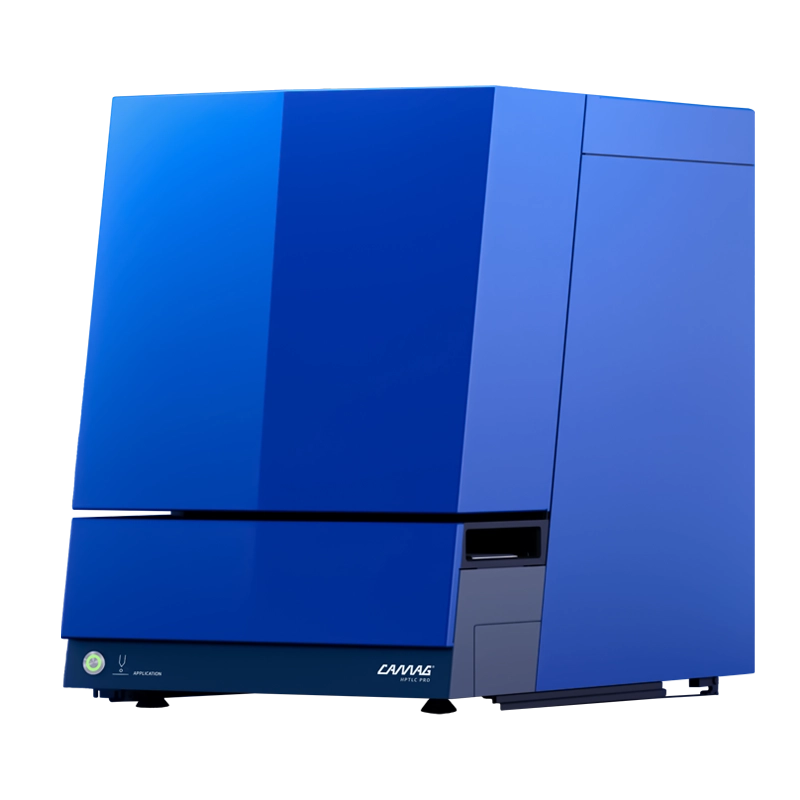
HPTLC PRO Module Application

CAMAG® HPTLC PRO Module APPLICATION

HPTLC PRO
Module Application

CAMAG® HPTLC PRO
Module Application

In a nutshell

Precise and Consistent Sample Application for Reliable Results

[application-large]
The fully automated HPTLC PRO Module APPLICATION is designed for highly precise application of samples as bands onto HPTLC glass plates.
75
samples on up to 5 plates

Controlled by visionCATS HPTLC Software, the autonomous application of up to 75 samples is supported (on up to five HPTLC plates).

  • Part of the fully automated HPTLC PRO SYSTEM
  • Autonomous application of up to 75 samples
  • Spray-on application of samples as bands
  • HPTLC glass plates (20 x 10 cm)
  • Software-controlled by visionCATS
HOW IT WORKS

SMOOTH & PRECISE OPERATION


  •  autonomously apply up to 75 samples across

    01

    The HPTLC PRO Module APPLICATION can autonomously apply up to 75 samples across five different plates. For continuous operation, pair it with the Module PLATE STORAGE, which automatically supplies new plates.

  • HPTLC PRO Module Application Detail

    02

    Laser-guided sample application ensures the optimal spraying distance. The needle distance and dosage speed adjust based on the solvent used, guaranteeing precise application of samples as narrow bands.

  • effective separation bubble

    03

    To prevent cross-contamination, the syringe creates an effective separation bubble between the rinsing solvent and the sample solution. The syringe is thoroughly cleaned after each sample application.

  • HPTLC PRO Module Application Detail

    04

    Following sample application, the integrated conveyor transfers the plate from the Module APPLICATION to the Module DEVELOPMENT for further processing.

KEY benefits

  • Highly precise application zones through optimized spraying procedure adapted for each sample solvent

  • Advanced cleaning capacities (two rinsing solutions)
  • Improved cleaning procedure and application strategy to prevent cross contamination
  • Minimized sample and solvent consumption
HPTLC PRO Module APPLICATION

Technical specifications

  • General data

    • Classification of installation and use
      Class I, installation category II, protection class IPX0, Pollution degree 1
    • Nitrogen or clean air pressure
      5 – 8 bar (70 – 110 psi)
    • Operating temperature
      15 – 30 °C
    • Recommended working temperature
      20 – 25 °C
    • Humidity
      Maximum relative humidity 80 % for temperatures up to 30 °C (Humidity and temperature conditions must not cause condensation!)
    • Plate types
      HPTLC glass plates 20 x 10 cm, layer thickness 200 µm
  • Electrical data

    • Operating voltage
      100 – 240 VAC; 50 / 60 Hz Fluctuations ±10 % of the nominal voltage Overvoltage category II
    • Power consumption
      40 W
    • Fuses
      2.0 AT, 250 VAC
    • Max. supply current from power outlet
      8 A
  • Mechanical data

    • Dimensions (W x D x H):
      384 x 550 x 510 mm
    • Weight
      ~ 33 kg

Continue reading

HPTLC PRO Module Development

CAMAG® HPTLC PRO Module DEVELOPMENT

HPTLC PRO
Module DEVELOPMENT

CAMAG® HPTLC PRO
Module DEVELOPMENT

In a nutshell

Full Automation for Reproducible and Efficient development

[development-large]

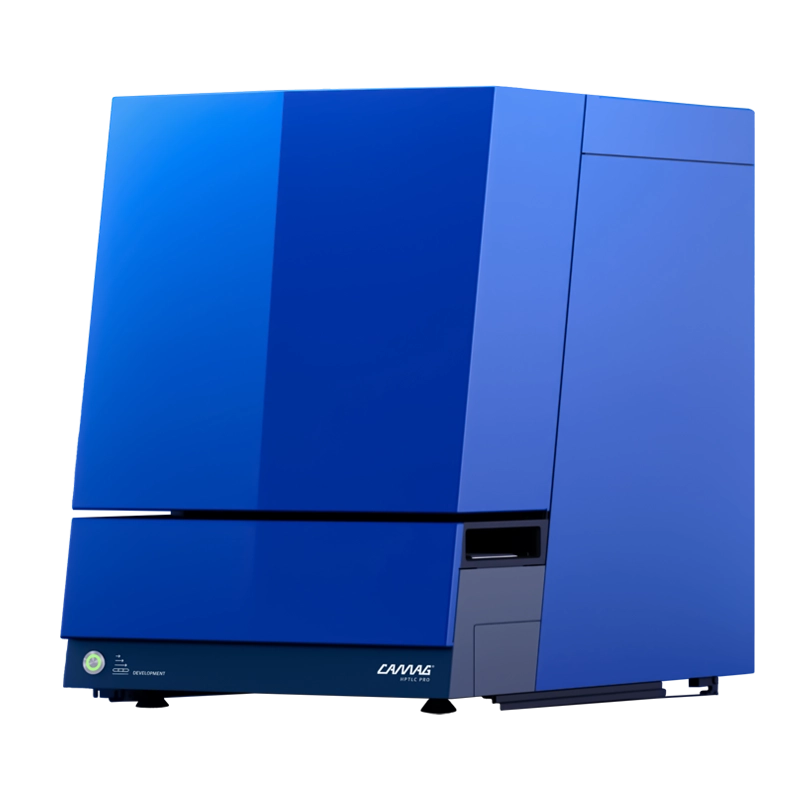
The advanced developing chamber of the HPTLC PRO Module DEVELOPMENT revolutionizes chromatography by fully controlling the gas phase, ensuring highly reproducible results, and significantly reducing pre-conditioning and activation time.

  • 5

    HPTLC glass plates
  • 3

    different developing solvents
75 Plates

Controlled by visionCATS HPTLC Software, the Module DEVELOPMENT autonomously develops up to five HPTLC glass plates (20 × 10 cm) sequentially, using up to three different developing solvents.

  • Part of the fully automated HPTLC PRO SYSTEM
  • Development of up to 5 HPTLC plates (20 x 10 cm)
  • Supports up to 3 different developing solvents
  • HPTLC glass plates (20 x 10 cm)
  • Software-controlled by visionCATS
HOW IT WORKS

SMOOTH & PRECISE OPERATION


  • HPTLC PRO Module Detail

    01

    After application of all samples, the plate is moved to the Module DEVELOPMENT.

  • HPTLC PRO Module DEVELOPMENT Detail

    02

    The plate containing the samples applied is ready to be loaded into the developing chamber.

  • HPTLC PRO Module DEVELOPMENT Detail

    03

    The tilting mechanism moves the plate from a horizontal to a vertical position into the developing chamber, where it is then developed according to the selected method.

  • HPTLC PRO Module DEVELOPMENT Detail

    04

    After development and drying in the chamber, the plate is returned to a horizontal position, ready to be transferred from the Module DEVELOPMENT to other modules for further processing.

KEY benefits

  • Low chamber volume for better control of the gas phase
  • Fast activation and pre-conditioning of the stationary phase (due to active circulation of the gas phase)
  • Full control of the gas phase during development
  • Sensor-controlled constant volume of the developing solvent in the chamber during development
  • Significant time savings due to active gas phase handling
  • Optimized cleaning procedure between different developing solvents
  • User-independent reproducibility

HPTLC PRO Module DEVELOPMENT

Technical specifications

  • General data

    • Classification of installation and use
      Class I, installation category II, protection class IPX0, Pollution degree 1
    • Nitrogen or clean air pressure
      5 – 8 bar (70 – 110 psi)
    • Operating temperature
      15 – 30 °C
    • Recommended working temperature
      20 – 25 °C
    • Humidity
      Maximum relative humidity 80 % for temperatures up to 30 °C (Humidity and temperature conditions must not cause condensation!)
    • Plate types
      HPTLC glass plates 20 x 10 cm, layer thickness 200 µm
  • Electrical data

    • Operating voltage
      100 – 240 VAC; 50 / 60 Hz Fluctuations ±10 % of the nominal voltage Overvoltage category II
    • Power consumption
      40 W
    • Fuses
      2.0 AT, 250 VAC
    • Max. supply current from power outlet
      8 A
  • Mechanical data

    • Dimensions (W x D x H):
      384 x 550 x 510 mm
    • Weight
      ~ 41 kg

Continue reading

HPTLC PRO Module Derivatization

CAMAG® HPTLC PRO Module DERIVATIZATION

HPTLC PRO
Module DERIVATIZATION

CAMAG® HPTLC PRO
Module Application

In a nutshell

micro-droplet spraying and plate heating in a single device

[derivatization-large]

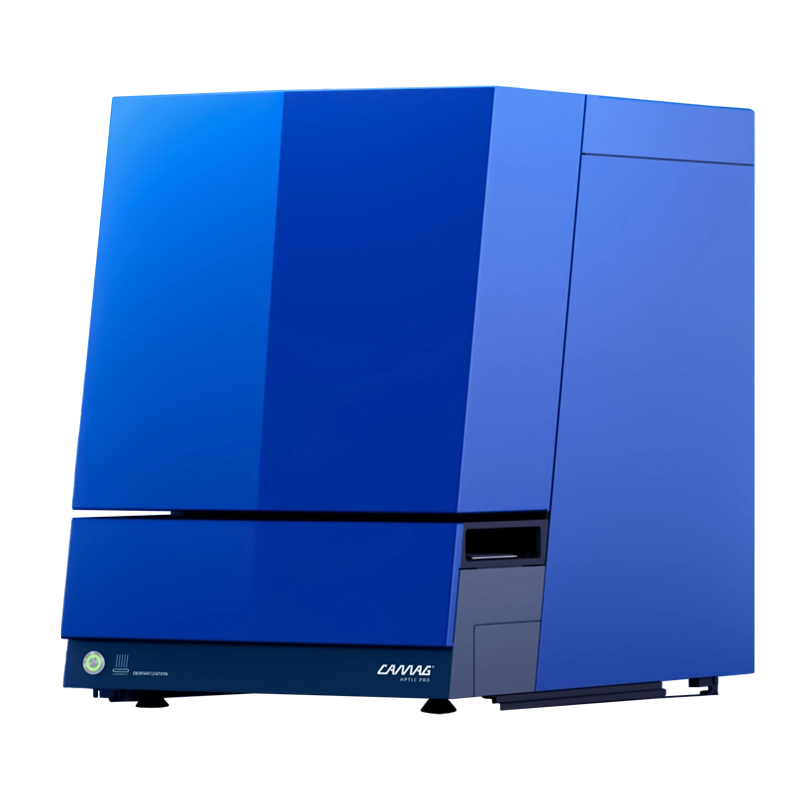
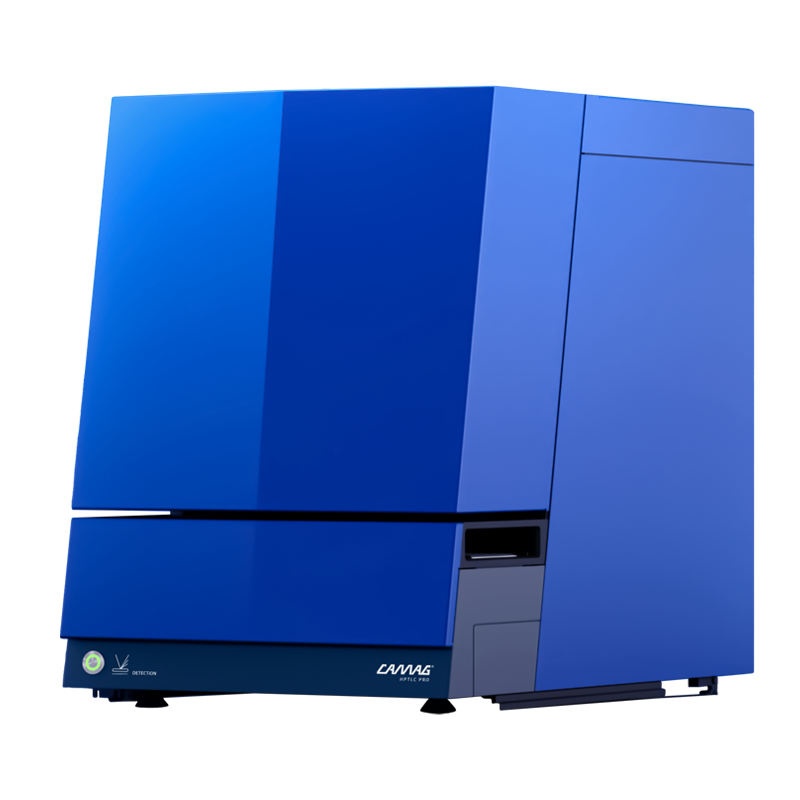
The HPTLC PRO Module DERIVATIZATION is designed for the fully automatic derivatization of HPTLC glass plates (20 x 10 cm) and uniquely combines two steps in a single device: high-precision spraying of derivatization reagents and heating of the plate.

  • 2

    steps in one instrument
  • 4

    different droplet sizes

Using patented micro-droplet spraying technology, the HPTLC PRO Module DERIVATIZATION achieves maximum uniformity in applying derivatization reagents, while the integrated plate heating unit ensures even heat distribution across the plate.

  • Part of the fully automated HPTLC PRO SYSTEM
  • Nozzle changer to choose nozzles from three parking positions
  • Integrated plate heating unit
  • Handling of two different derivatization reagents
  • HPTLC glass plates (20 x 10 cm)
  • Software-controlled by visionCATS
HOW IT WORKS

SMOOTH & PRECISE OPERATION


  • HPTLC PRO Module DERIVATIZATION Detail

    01

    The HPTLC PRO Module DERIVATIZATION features four spraying nozzles generating different droplet sizes to suit the properties of the selected reagent.

  • HPTLC PRO Module DERIVATIZATION Detail

    02

    A sophisticated gripper mechanism inserts the nozzle into the nozzle adapter prior to spraying and subsequently moves it to the integrated cleaning station.

  • HPTLC PRO Module DERIVATIZATION Detail

    03

    Employing the patented micro-droplet spraying technology, the reagent spraying nozzles generate an extremely fine reagent mist, which evenly distributes in the derivatization chamber and gradually settles down on the plate.

  • HPTLC PRO Module DERIVATIZATION Detail

    04

    The cleaning station washes the nozzle from the inside and the outside. Meanwhile, the HPTLC plate is moved to the subsequent heating step.

KEY benefits

  • Spraying and heating in a single device

  • Highest user safety through automation and fume hood connection

  • Optimal cleaning procedure between nozzle changes

  • Low reagent consumption (3 mL)

  • Maximum homogeneity in reagent and heat distribution

HPTLC PRO Module DERIVATIZATION

Technical specifications

  • General data

    • Classification of installation and use
      Class I, installation category II, protection class IPX0, Pollution degree 1
    • Nitrogen or clean air pressure
      5 – 8 bar (73 – 116 psi)
    • Operating temperature
      15 – 30 °C
    • Recommended working temperature
      20 – 25 °C
    • Humidity
      Maximum relative humidity 80 % for temperatures up to 30 °C (Humidity and temperature conditions must not cause condensation!)
    • Plate types
      HPTLC glass plates 20 x 10 cm, layer thickness 200 µm
  • Electrical data

    • Operating voltage
      100 – 240 VAC; 50 / 60 Hz Fluctuations ±10 % of the nominal voltage Overvoltage category II
    • Power consumption
      250 W
    • Fuses
      4.0 AT, 250 VAC
    • Max. supply current from power outlet
      8 A
  • Mechanical data

    • Dimensions (W x D x H):
      384 x 550 x 510 mm
    • Weight
      ~ 35 kg

Continue reading

CAMAG® HPTLC PRO Module DETECTION

HPTLC PRO
Module Detection

CAMAG® HPTLC PRO
Module Detection

In a nutshell

Comprehensive Analyte Characterization and Quantification

[detection-large]

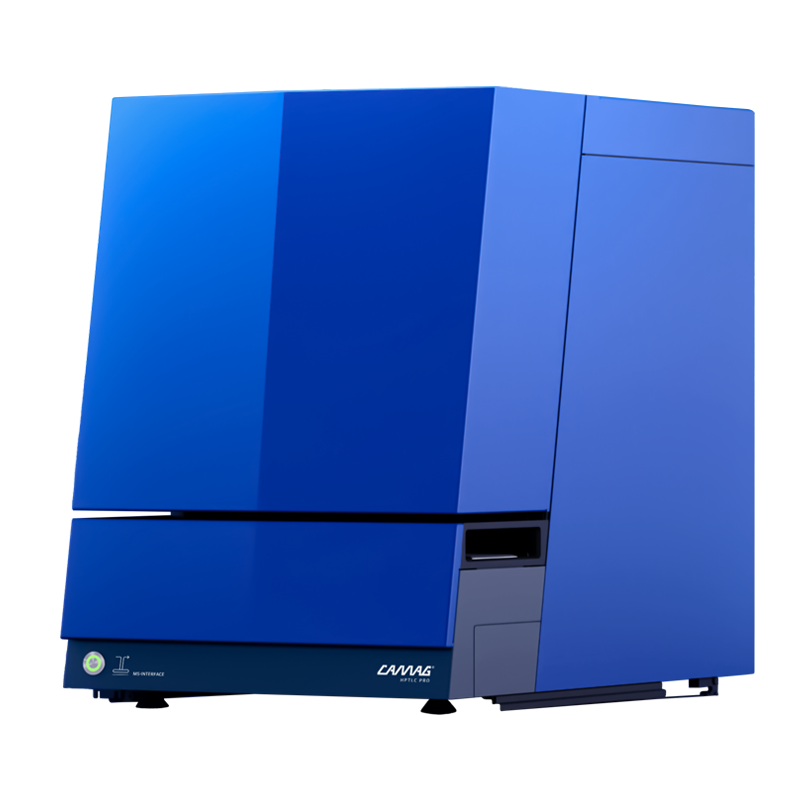
The HPTLC PRO Module DETECTION – anticipated launch in 2025 – employs hyperspectral imaging technology to characterize and quantify all analytes.

visionCATS enables the preparation of an unlimited number of analysis files for sequential use.

  • Part of the fully automated sample analysis and evaluation by HPTLC PRO
  • Excitation with Xenon
  • Detection range from 200 – 830 nm
  • Absorbance and fluorescence measurement
  • Evaluation of acquired hyperspectral data with visionCATS and AI

Continue reading

CAMAG® HPTLC PRO Module MS-INTERFACE

HPTLC PRO
Module MS-INTERFACE

CAMAG® HPTLC PRO
MS-INTERFACE

In a nutshell

Seamless Integration with MS for Precise Analyte Identification

[ms-interface-large]

The HPTLC PRO Module MS-INTERFACE, set to launch in 2025, will enable fully automated direct elution of bands from the plate.

Any position on the plate can be selected through the visionCATS software for automatic elution via the integrated elution pump. The eluate can then be transferred to a mass spectrometer or collected for further offline analysis.

  • Part of the fully automated sample analysis and evaluation by HPTLC PRO
  • Automated positioning of the elution head, also based on previous evaluation
  • Either connected to an MS or fraction collector
  • Optimal cleaning procedure between elutions
  • HPTLC glass plates (20 x 10 cm)
  • Software-controlled by visionCATS

Continue reading

CAMAG® HPTLC PRO Module PLATE STORAGE

HPTLC PRO
Module PLATE STORAGE

CAMAG® HPTLC PRO
Module PLATE STORAGE

In a nutshell

Efficient plate management for sequential analyses

[plates-large]

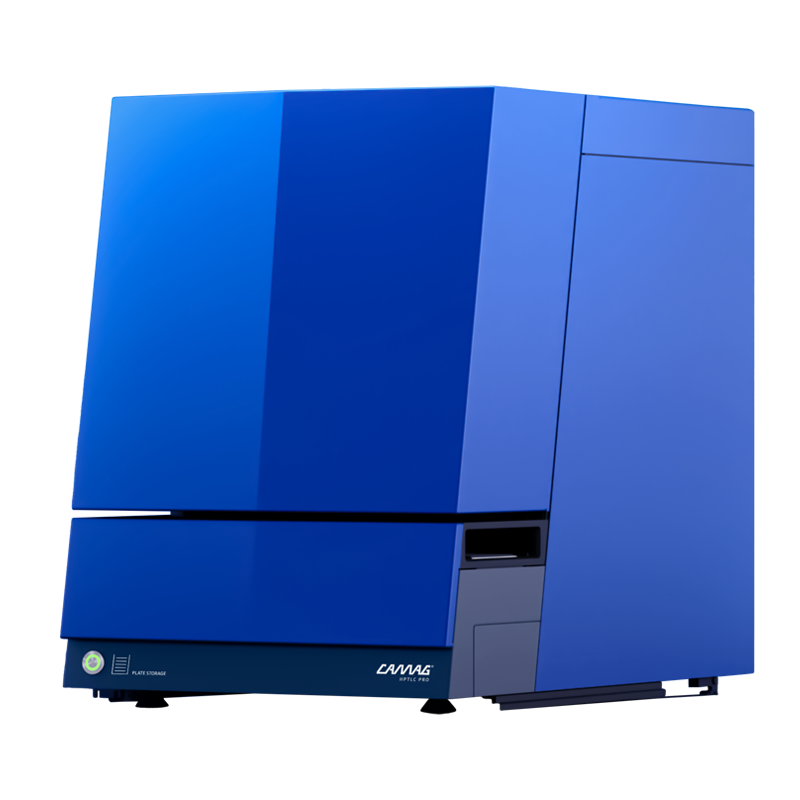
The HPTLC PRO Module PLATE STORAGE is the basis of a fully integrated and automated HPTLC workflow, making your laboratory processes more efficient and dependable than ever.

5

HPTLC glass plates

Designed for a streamlined workflow, this advanced Module ensures that plates are carefully managed under controlled conditions, preserving their integrity for subsequent analysis or documentation.

With the ability to handle multiple plates in sequence, the Module PLATE STORAGE optimizes efficiency while safeguarding against external influences that could compromise the quality of your results. Whether you’re working with complex analyses or routine procedures, this module guarantees that your plates are stored with precision, ensuring consistency and reliability across all stages of the HPTLC process.

  • Part of the fully automated HPTLC PRO SYSTEM
  • Automated feeding of up to five HPTLC plates into the system
  • Two stackers hold up to five clean and five processed HPTLC plates, with an active fume extraction system
  • HPTLC glass plates (20 x 10 cm)
  • Software-controlled by visionCATS
HOW IT WORKS

SMOOTH & PRECISE OPERATION


  • 01

    Holding up to five HPTLC glass plates, the Module PLATE STORAGE feeds the HPTLC PRO SYSTEM with clean plates and enables running a sequence of analyses autonomously overnight.

  • 02

    After or during analysis, the plates are transported back to the Module PLATE STORAGE.

  • 03

    The built-in conveyor transports clean plates from the Module PLATE STORAGE to the Module APPLICATION.

  • 04

    To avoid cross contamination, the stacker for processed plates features a fume extraction system for the active suction of vapors.

KEY benefits

  • Enables the autonomous processing of up to five HPTLC plates in the HPTLC PRO SYSTEM
  • One-time plate loading prior to the analyses improves workflow and efficiency
  • Optimal process time through seamless plate loading and unloading
  • No cross contamination of plates due to storage in separated compartments

  • Possibility to run a sequence of analyses autonomously overnight
HPTLC PRO Module PLATE STORAGE

Technical specifications

  • Operating temperature

    15 – 30 ° C
  • Recommended working temperature

    20 – 25 ° C
  • Plate types

    HPTLC glass plates 20 × 10 cm
  • Operating voltage

    100 – 240 VAC; 50 / 60 Hz
  • Power consumption

    30 W
  • Dimensions (W × D × H)

    384 × 550 × 510 mm
  • Weight

    ~ 29 kg

Continue reading

CAMAG® HPTLC Software visionCATS

HPTLC Software visionCATS

Request consultation

In a nutshell

HPTLC analysis – made easy

visionCATS is built for simplicity and intuitive operation, streamlining the entire HPTLC workflow by controlling both HPTLC PRO Modules and HPTLC instruments while efficiently managing data.

With its user-friendly interface, visionCATS guides users smoothly through the entire chromatographic process, from sample setup to report generation. Starting is easy—select a default method, fill in the sample table, choose a developing solvent, and select a derivatization reagent. Detection parameters can be customized as needed, and visionCATS leads users through each step.

Creating custom methods is equally straightforward. Users can easily select the required steps, and the sample-oriented design enables the creation of virtual plates by combining tracks from different plates. This feature is especially useful for batch-to-batch comparisons and long-term stability testing.

Finding relevant samples is made faster with a robust search tool in the file explorer. Users can search by text, date, samples, methods, or analysis files, with extended preview options. Custom search filters can also be created, allowing for even more streamlined navigation and data retrieval.

  • Comparison Viewer
  • Image Enhancement Tools
  • Scanning Densitometry and Spectral Evaluation
  • Quantitative Analysis
  • HPTLC Method Library
  • Regulatory Compliance

Key Features

  • Comparison Viewer

    With visionCATS integration, the TLC Visualizer 3 allows extraction and export of selected sample data from acquired images for easy comparison. References and samples from the same or different plates and detection modes can be displayed side by side, ensuring full traceability of all data for regulatory compliance.

  • Image Enhancement Tools

    visionCATS supports low-noise, high dynamic range (HDR) imaging and allows to edit images acquired with the TLC Visualizer 3, offering a set of enhancement tools. Sophisticated algorithms guarantee the highest image quality for identification of even the faintest zones.

  • Scanning Densitometry and Spectral Evaluation

    Following their chromatographic separation substances on the plate can be measured by Scanning Densitometry using the TLC Scanner 4. Recording of UV/VIS spectra and their comparison with reference spectra allows identification and comparison with spectra from reference libraries.

  • Quantitative Analysis

    Five quantification functions, including linear and polynomial regression, are available for determining substance concentration after densitometric or image-based analysis. Multiple scans and up to five evaluations can be performed within a single analysis file.

  • HPTLC Method Library

    For seamless import of validated methods and images of standards and reference materials, visionCATS provides a free of charge HPTLC Method Library for licensed users.

  • Regulatory Compliance

    visionCATS HPTLC software ensures regulatory compliance by supporting GMP/GLP guidelines and 21 CFR Part 11 requirements. With audit trails, user access controls, and electronic signatures, it secures data integrity and traceability, making it ideal for regulated environments.

HOW IT WORKS

SMOOTH & PRECISE OPERATION


  • HPTLC Analysis-made easy

    HPTLC Analysis – Made Easy

    01

    HPTLC Analysis – Made Easy: Create your own method with a few mouse clicks.

  • Guided Analysis

    Guided Analysis

    02

    Guided Analysis: Select a method and visionCATS will guide you

  • Sample View

    Sample View

    03

    Sample View: All available data related to the sample are displayed

  • Data Preview

    Data Preview

    04

    Data Preview: Provides an overview of steps and samples of an analysis or method

  • Profile Comparison

    Profile Comparison

    05

    With visionCATS, it is possible to compare profiles of samples developed in different analyses.
     

Comparison & Enhancement Tools

DOCUMENTATION WITH
TLC VISUALIZER 3

Controlled by visionCATS, the TLC Visualizer 3 can generate low-noise, high-dynamic-range images (HDRI). These images can be separated into tracks representing single samples. Any sample that has ever been analyzed can be directly compared with any other sample using the Comparison Viewer. Samples can be rearranged and compared to reference substances or samples, independent of their plate origin. Also 3D profiles of images can be generated.

The comprehensive set of Image Enhancement Tools in the Data View exploits the TLC Visualizer’s full potential. Images are automatically captured based on an optimized control of the illumination and parameters specified in the HPTLC method. Sophisticated algorithms guarantee the highest image quality for identification of even the weakest zones. The Data View allows visual evaluation of a plate in different illumination modes and offers a broad range of helpful tools, e.g. the RF tool displays the RF value of zones on the digital image, or a rectangular and/or linear zoom function.


  • TLC Visualizer 3 visionCats Data view

    Data View:

    01

    Data View: All data gathered through the chromatographic process can be reviewed and processed

  • TLC Visualizer 3 visionCats Comparison Viewer

    Comparison Viewer

    02

    Comparison Viewer: Side by side view of tracks from the same or different plates and/or detection modes

  • spot-amp-off

    Image Enhancement

    03

    Spot Amp efficiently supports the localization of even the smallest fractions on the plate by increasing or decreasing the contrast of the zones.

Quantitative evaluation

Quantification with
TLC Scanner 4

visionCATS controls the TLC Scanner 4 and enables quantitative evaluation of the generated densitometric data. The spectral range of light from 190 to 900 nm is available for selecting single wavelengths for Scanning Densitometry. Detection can thus be fine-tuned to match the spectral properties of the analyte to its optimized specificity and sensitivity of the detection. For almost unlimited flexibility, several scanning steps, e.g. before and after derivatization, can be selected. Each scanning step may also include up to 31 individual multi-wavelength scans using different light sources (deuterium lamp, mercury lamp, tungsten lamp). The detection modes absorbance or fluorescence can be combined. The generated data can then be evaluated. Integration of peaks and assignment to separated substances is a matter of a few mouse clicks.
Quantification of substances can be performed via peak height or peak area. The best fitting calibration model with single-level calibration or multilevel calibration via linear, polynomial or Michaelis-Menten regression is selected. With visionCATS and the TLC Scanner 4 UV spectra can be measured as well. The selected peak positions, which are detected from a previous densitogram, are automatically scanned at the defined wavelengths. Spectra can be measured from 190 to 900 nm and displayed individually or overlaid in one diagram. Spectra recorded on different plates can be compared with the Comparison Viewer.

  • Substance assignment

    Peak Assignment

    01

    Peak Assignment: The separated compounds are assigned. For quantification, data from the multi-wavelength scan at the optimum wavelength for each compound is used.

  • Image profile in 3D view

    3D View and Peak Integration

    02

    3D View and Peak Integration: Densitograms are displayed in 3D, top or front view. Several peak integration and baseline correction settings can be selected.

  • Calibration curve

    Calibration Curve

    03

    Calibration Curve: For evaluation the best fitting calibration model is used. Quantitation can be done via peak height or area.

database

visionCATS
Method Library

For analysts using HPTLC for identification of herbal drugs or analysis of food samples, visionCATS offers breakthrough support with the visionCATS Method Library. As a licensed visionCATS user, you can download methods from the visionCATS Method Library free of charge and import them into your own visionCATS database.
Each method includes three files:
  • A method documented in a form (e.g. docx) which may serve as an SOP and which can be easily incorporated into any quality management system. This file contains a description of the System Suitability Test (SST) and acceptance criteria for compliant herbal drugs.
  • An instrument method ready to use in visionCATS. A new analysis with all method relevant information (reference substances, plate layout, stationary and mobile phase, etc.) can then be processed. Only the Vial ID of the sample to be analyzed needs to be entered.
  • A Comparison Viewer file with reference images against which each analyzed sample can be compared and evaluated, based on acceptance criteria specified in the method document. After comparing the data of the samples with the reference images individual reports can be generated by a mouse click.
The HPTLC Method Library contains methods included in the USP Dietary Supplement Compendium and those published by the International Association for the Advancement of HPTLC. Numerous methods of identification from the European Pharmacopoeia are added as well. Additional methods will be added continually.
Method-Library-1

Regulatory Compliance

secure, safe, and audit-ready

  • 21 CFR Part 11

    The option 21 CFR Part 11 supports customers to work in a controlled environment and to establish regulatory-compliant processes. As a part of 21 CFR Part 11 compliance, electronic signature processes are available. A set of log files (System log; Method log; Analysis log; Backup log) are available to fully meet 21 CFR Part 11 requirements.
  • Qualification

    For customers working in a cGMP/cGLP environment, CAMAG offers Installation Qualification (IQ) and Operation Qualification (OQ) services.
  • System Suitability Test (SST)

    System Suitability Tests are used on each plate to check and ensure that the analysis was performed appropriately to produce results that are within the acceptance criteria established during method development. Only data from plates qualified by the respective SST can be directly compared. The SST is the primary tool for evaluation of data during a transfer validation. visionCATS provides several tools for setting up a SST.
  • Data Security

    Data Security is achieved through access control, which is provided by a flexible, secure, and customizable User Management System and basic system settings. Users are defined with rights that determine the level of access they have. The User Management System is compatible with Active Directory. With the powerful user management, it is possible to reflect the customers’ individual safety regulations. Data are stored in a safe database to prevent accidental alteration/deletion.
  • Data Safety

    The visionCATS Backup Assistant helps users to store their data into a backup file. Automatic backup tasks can be defined with the Schedule Assistant. With the Restore Assistant users can easily restore their data from the backup file.

Continue reading